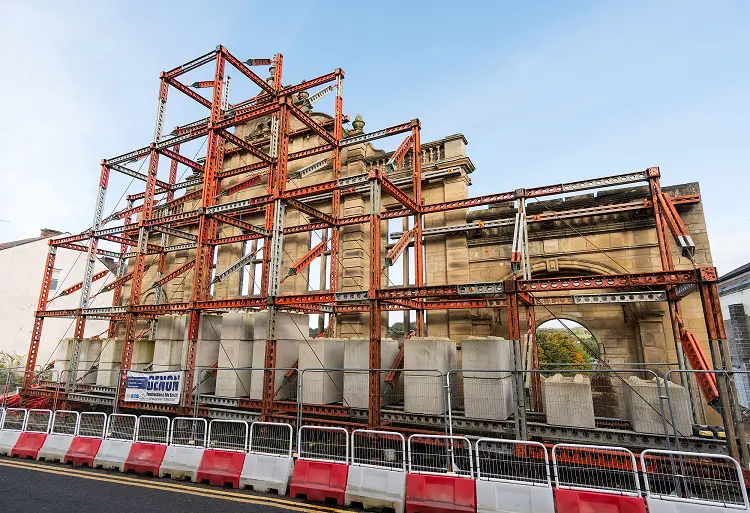



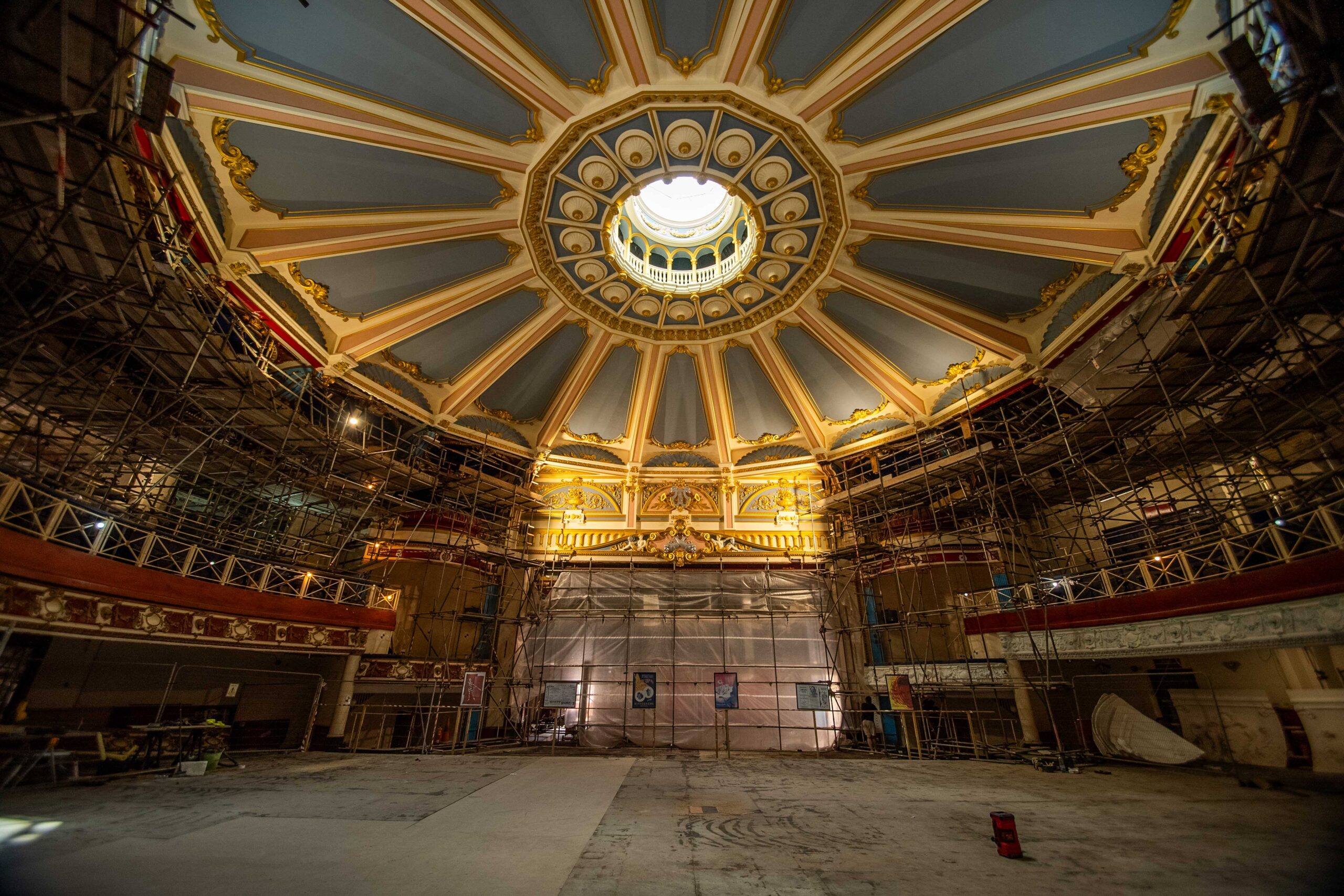
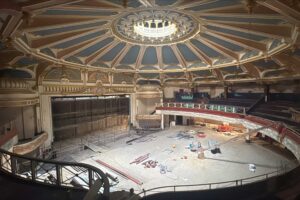
The famous Brighton Hippodrome is on a phased journey back to use after a long period of vacancy. The aim is to return the former entertainment venue to its former glories, one that hosted the likes of The Beatles and The Rolling Stones.
It’s an example of the risks brokers see on heritage schemes. At Renovation Underwriting, this is the kind of project we understand instinctively and is a big part of why we were set up. We have a clear affinity with heritage work because supporting our built heritage is part of protecting it for future generations. Our role is to help brokers place complex heritage renovations properly from beginning to end.
Protecting historic buildings is not because they look impressive, but because it takes careful planning and disciplined risk control from start to finish. A heritage scheme of this nature doesn’t fail with one dramatic moment. It tends to fail through a sequence of smaller exposures compounding: a period of vacancy where risk controls loosen, the highest-exposure phase of the programme where historic structure and new works are inseparable, and handovers where responsibility shifts faster than the paperwork can keep up.
The Hippodrome is a useful example because it has all the ingredients brokers recognise – a listed venue in a tight urban setting, a significant period of inactivity, specialist heritage elements, and a phased journey from core building works through to operator fit-out. This project is being delivered in two stages. The owner is responsible for shell-and-core restoration, the external envelope, and statutory compliance, before the building is handed over to the operator for the detailed fit-out and interfacing works through to completion.
On complex projects like this, insurance is never a formality, but it is an essential part of the build plan.
Why vacancy is a phase, not a status
Vacancy is often treated as a holding pattern. Instead, it’s an active risk phase, and on prestige buildings left alone for long periods, it can have serious detrimental effects.
If you’ve ever walked a vacant listed venue, you know how quickly small issues can become big ones, and over time these problems can develop slowly and quietly. For example, water ingress is less likely to be spotted early, minor faults stack up and become more difficult, and security concerns evolve. Insurance cover conditions can tighten as unoccupancy continues and it can become easy to assume that nothing is happening when in reality the issues can increase, and it becomes a period that requires stringent management.
As brokers, this should be a point of confidence. If you can evidence inspections, sensible water precautions, and site security that reflects the building’s weak points, you’re not taking a punt on a difficult risk. You’re placing a controlled one, with a clear transition into works cover when the programme moves on.
Heritage reinstatement is not decoration, it’s critical path
Heritage risk and historic features require a full schedule and method statement, covering working methods, tools, materials, treatments and colours, when undergoing renovation. It should also include a timetable for implementation and completion, and detailing the list of requirements across project stages, with expectations at shell-and-core and again at the later detailed fit-out.
That is a practical signal to brokers that reinstatement is specialist, staged, and tightly controlled. On a listed venue, a small loss can become a heritage loss, and then it becomes a question of whether what was lost can be matched, how long specialist trades can implement, and what that does to the programme and the commercial plan.
Brokers should establish early:
- What must be protected during the live works phase
- How temporary protection will work as different trades rotate through the building
- What the plan is for sequencing, interfaces, and responsibility when areas are partially complete
These are simple questions, but reduce ambiguity, which is where claims costs can often escalate.
Handovers are where cover fails quietly
Most heritage schemes are not just delivered by one party. They move through phases with different people responsible for different parts of the building.
The Hippodrome is a good example of a structure brokers see regularly. The owner delivers the base building works, including shell-and-core restoration and the external envelope, then hands the site over to the operator to complete the detailed fit-out and interfacing works. That handover point is a programme milestone but it’s also a risk event.
It can be where scopes overlap and where unfinished systems and partially completed areas create openings for loss. It’s also where misunderstandings can become expensive, because claim questions are blunt: who was responsible, what was insured, and what was the condition of the building at the time?
This is where, as brokers, you can add real value. By mapping responsibilities to phases, confirming how the existing structure is treated throughout, and making sure that cover follows the reality of the site, the client will feel the difference, as will the insurer.
It’s important to remember that these are not “place and forget” risks. They benefit from in-project engagement by the broker and insurer, to make sure risk management stays in place as the site conditions change.
Why change matters to brokers
On complex schemes, design changes are normal once an operator is appointed and requirements become clearer.
This is where ongoing broker and insurer engagement pays for itself, because the risk controls need to stay aligned as the scope shifts.
For brokers, the detail matters less than the pattern. When scope shifts, the risk picture shifts with it. Ensure controls and responsibilities stay aligned as the project evolves, so the placement continues to match what’s happening on site.
Major heritage losses such as Glasgow School of Art and Notre Dame sit in the collective memory of brokers and underwriters, and they underline why attention to detail matters on listed building work.
Five questions that help brokers place heritage projects with confidence
If you are placing a heritage venue, consider starting with these five questions.
- Where are we in the programme today, and what changes in the next phase?
Vacant, enabling, shell-and-core, fit-out, opening. The risk moves with the phase, so the cover and controls need to move with it too. - What evidence do we have that vacancy risks are being managed properly?
Inspection frequency, water precautions, security measures, and who is accountable for them. - What counts as historic fabric here, and how is it being protected during live works?
The Hippodrome has historic features that require defined methods, materials, and a timetable across stages. - Where do responsibilities change, and how do we avoid gaps at handover?
On Hippodrome, the model is shell-and-core and envelope works first, then handover to the operator for fit-out and interfacing works.
Brokers add value by making sure responsibility, joint names, and cover continuity are explicit at each transition. - What is the one milestone the project cannot afford to miss?
For venues, the end point is opening, not just practical completion. The placement should reflect that commercial reality.

Broker perspective: what makes these placements work
Clara Boyce, Commercial Account Executive at Brown & Brown, and a specialist in renovation insurance says that the Brighton Hippodrome is fascinating, but complex for a simple reason: when a listed venue is involved, it is vital that cover is structured correctly so that the building owner, contractor, and tenant are all protected, particularly where the tenant has fit-out responsibilities and opening-time pressures.
She highlights that these are not quick quotations. They take time to shape because information has to be gathered, tested, and presented properly to insurers. Starting early matters because the project evolves, and what might look like a straightforward question often opens up several more once you begin drilling into methods, sequencing, responsibilities, and who is accountable for what on site.
She also stresses that placement is only half the job. A big challenge is managing client expectations in asking the right questions and providing the right documentation early. For projects of this size and complexity, it is vital that the client understands the conditions and value of the cover from the outset, so the project stays on track, rather than having to chase for important paperwork at the last minute.
Why this category should appeal to brokers
Listed heritage venues are not risks that should be viewed with scepticism. Providing solutions to complex heritage risk profiles is challenging, but also incredibly rewarding. Placing these risks protects our UK heritage estate for the community at large.
Instead, these should be viewed as disciplined risks, and brokers who ask the right questions early can place them with confidence.
But there is a market reality here. If there is little appetite in the insurance market, many of these schemes stall because the exposures are too large and the risks too varied to be taken on casually. Our underwriting approach is built for that variation, and for the capacity required to deal with large existing structure exposures. Put simply, a disciplined placement with the right capacity, and an approach that properly handles existing structure exposure, is often what keeps projects moving.
If you can structure cover around the project phases, insist on clear protection for historic fabric during the highest-exposure phase of the programme, and remove ambiguity at handovers, you can place schemes like this with assurance. The client feels supported, the project team gets fewer surprises, and if something does go wrong you are far less likely to be caught in a gap between responsibilities, scopes, or policy wording.
At Renovation Underwriting, we help brokers take on complex heritage renovation risks by applying calm specialist thinking to real site conditions: what the building is, what stage it is in, who is responsible for what, and how the risk changes as the programme moves from vacancy to shell-and-core, then into fit-out and opening. Our aim is to provide clarity, not assumptions.